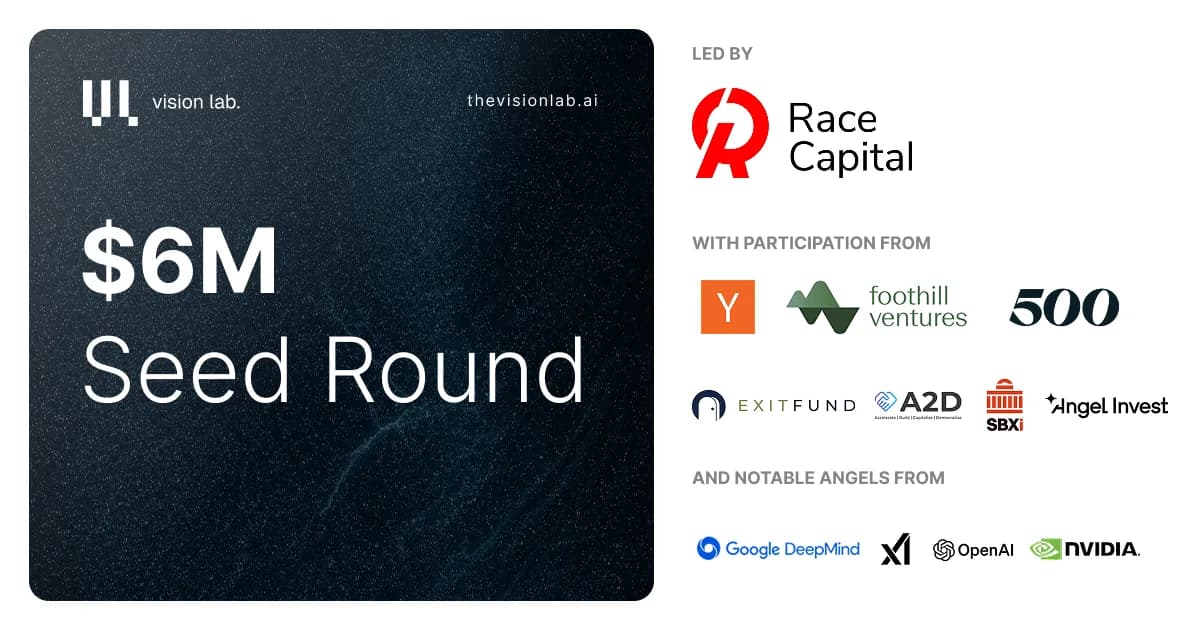
san francisco · jun 3, 2026. Vision Lab, a startup founded by MIT and Stanford researchers, today announced the close of its $6M seed round, led by Race Capital, with continued participation from Y Combinator and new institutional backers including Foothill Ventures and 500 Global. The company provides real-world industrial data to frontier AI labs and robotics companies through a global network of more than 2,000 factories.
the physical ai data wall
While large language models were trained on internet-scale datasets, robotics foundation models still lack the massive volumes of real-world data needed to achieve similar breakthroughs. Public robotics datasets remain only a tiny fraction of what will be required to train general-purpose robotics models, with industrial environments especially underrepresented. Yet factories, warehouses, and production facilities are among the most important environments for future robot deployment.
Recent advances in robotics increasingly rely on transfer learning from human motion to robotic motion. By observing how humans interact with tools and environments, such as watching a technician use a screwdriver, robotics models can learn manipulation patterns and transfer that understanding into robotic control systems.
Physical AI will require a different kind of data infrastructure than language models. Robotics teams need access to real industrial environments, real workflows, and real human task execution at scale. Vision Lab has built one of the hardest parts of that stack: a trusted global factory network for collecting and structuring the data needed to train and deploy physical AI systems.
chris mccann · general partner, race capital
what vision lab has built
Vision Lab operates one of the largest industrial data collection networks across Asia and Africa, with expansion underway into Latin America. Through these partnerships, the company captures, structures, and annotates real-world industrial video from active production environments. Its datasets include both egocentric footage, showing how trained workers perform tasks, and exocentric footage, capturing broader factory context, workflows, tools, and operating conditions.
The company has already delivered industrial robotics datasets to multiple frontier AI labs, including three of the Magnificent Seven tech giants.
building toward future robotics deployment on the factory floor
Vision Lab’s factory network is designed not only for data collection, but also to become part of the future deployment infrastructure for physical AI systems.
As robotics companies move beyond model pretraining toward reinforcement learning and real-world deployment, access to diverse operational environments will become increasingly critical. By operating across a global network of factories already represented within training datasets, Vision Lab helps bridge the gap between model training and real-world execution.
We are not just building datasets. Our long-term goal is to help robotics systems operate reliably in real production environments, whether that means supporting safer factory operations, reducing labor bottlenecks, or making industrial automation more accessible globally.
james kujareevanich · ceo, vision lab
The new funding will be used to expand Vision Lab’s global factory network, scale its data pipeline infrastructure, and grow the engineering and operations teams supporting large-scale data capture and curation.
about vision lab
Vision Lab curates real-world industrial data for frontier AI labs and robotics companies. Founded by researchers from MIT and Stanford alongside operators from McKinsey and BCG, Vision Lab is headquartered in San Francisco. Factories interested in joining the Vision Lab network can get in touch.